


Ban on F24 offsets 2026: threshold drops to 50,000 euros
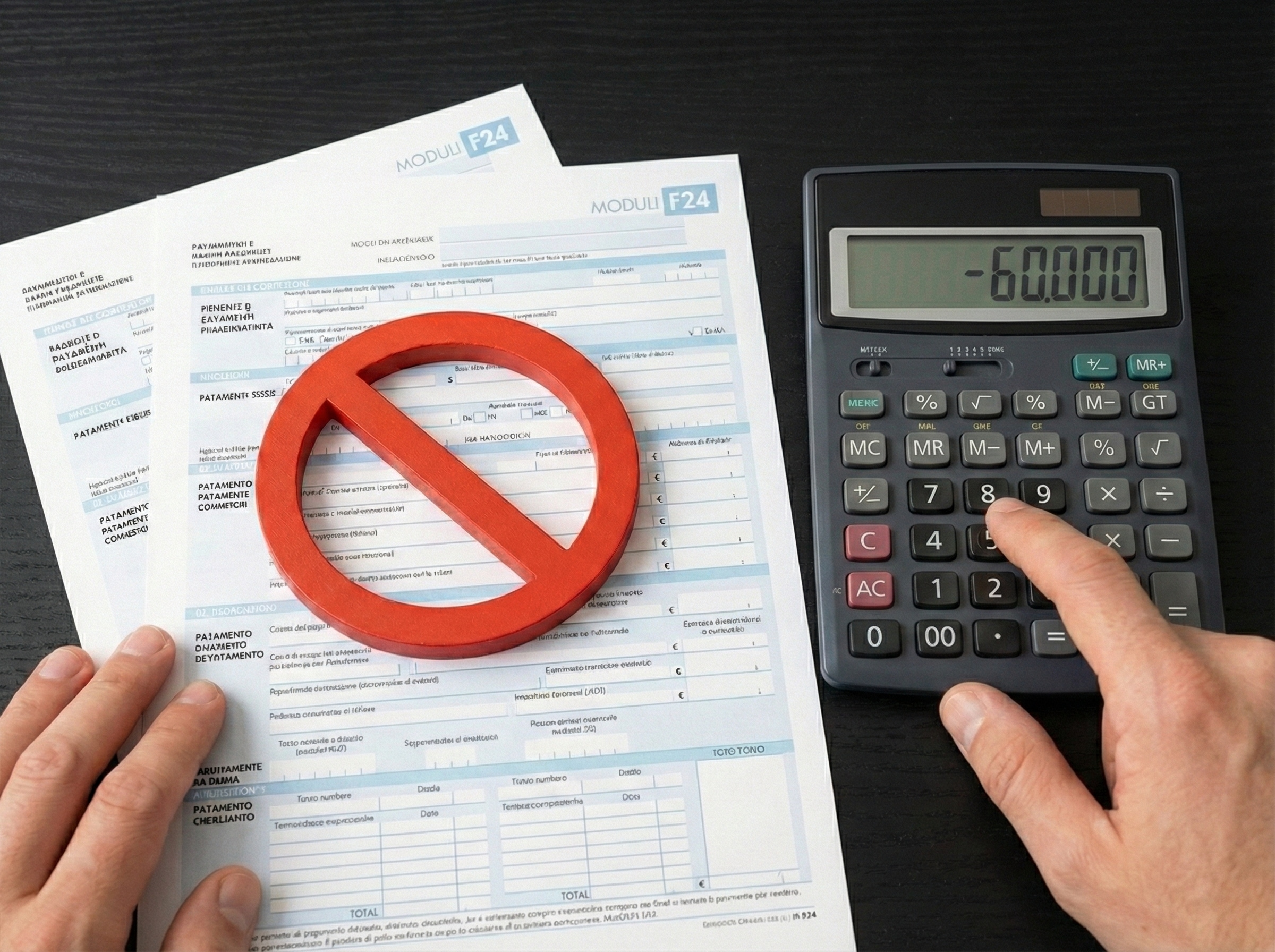

- Ban threshold: from 100,000 euros to 50,000 euros
- If you exceed the threshold, no horizontal offsets in F24
- INPS credits and INAIL premiums remain offsettable
- Operational risk: F24 can be rejected
- Check roles and repayment plan before offsetting
What is the offsetting ban and what changes in 2026?
The ban on offsetting in F24 blocks the use of tax credits in the presence of tax debts registered in the tax roll or entrusted for collection beyond a certain threshold. From 2026, the threshold lowers: from 100,000 euros to 50,000 euros. The result is an expansion of the audience of blocked companies, even if they have never had structural problems but only temporary debt peaks.
A company with 70,000 euros of expired tax roles in 2025 could still offset; in 2026 it risks not being able to do so, with an immediate impact on liquidity.
Which debts trigger the block?
The ban operates in the presence of expired tax roles or executive assessments entrusted for collection for state taxes and related accessories, beyond the overall threshold. The issue is not just how much I owe, but the status of the debt: expired, entrusted, suspended, paid in installments. In many companies, this data is not updated in the general ledger, because it lives between PECs, the tax drawer and communications from the collection agent.
Before setting up offsets, periodic monitoring (monthly or bi-weekly) is needed that crosses the tax roll extract, deadlines, and the status of installment plans. A check at the end of the quarter may arrive too late and cause operational surprises.
Which credits remain offsettable despite the ban?
A part of the credits remains usable: the rule provides for exceptions, including credits relating to social security contributions and INAIL premiums. This distinction creates a practical effect: the treasury must separate the flows. It’s one thing to use a VAT credit to zero out an F24, another is to use INPS/INAIL credits which remain permitted.
Horizontal offsetting uses credits of a different nature to pay debts; vertical offsetting more often works within the same tax. In the company, the difference is not theoretical: it changes who controls it, what risks there are and what information systems are needed.
What happens if you send an F24 in violation of the ban?
The most dangerous risk is operational: the F24 can be rejected, resulting in non-payment. When the F24 is rejected, the company may believe it has paid (because it prepared the file and perhaps authorized it), but in reality the debt remains open. This generates interest, penalties, and above all further chain problems.
In SMEs, the F24 rejection is one of the most frequent causes of unexpected holes in bank-tax reconciliation. The problem often emerges when asking for a DURC or when a bank raises attention to tax risks.
How to manage the impact on liquidity: three practical strategies
Strategy 1: priority to getting back below the threshold. If you fall below 50,000 euros with a targeted payment, the possibility to offset reopens. It is not always the cheapest solution, but it is often the quickest.
Strategy 2: installment plans correctly (where possible). If the debt is paid in installments and in order, the effect on the block may change. However, rigorous management of deadlines is required.
Strategy 3: reschedule the use of credits. Some credits are precious for the treasury. If they cannot be used in F24, they must be replanned and perhaps transformed into a recovery or refund plan, when available.
These strategies must also be evaluated with bank covenants. A spot tax payment can improve compliance but worsen the cash position to the point of violating a financial indicator.
Practical case: company with VAT credits and tax roles at 60,000 euros
Business with 80,000 euros of VAT credit and 60,000 euros of expired state tax roles. In 2026, the VAT credit is not spendable in offsetting until the company falls back below 50,000 euros. If the treasury was counting on that offsetting to zero out payments for the quarter, an alternative plan is needed.
In these cases, speed makes the difference: timely control avoids rejected F24s and allows setting up a sustainable repayment plan, perhaps by combining targeted payments and renegotiation of deadlines.
F24 Audit: avoid rejections and monitor liquidity
The operational risk is real: rejected F24 = open debt + interest + surprise in treasury. If you manage numerous F24 payments or have significant credits, a check from January is needed before problems emerge from the bank or DURC.
Gruppo AQ offers:
Gruppo AQ offre:
- Audit della posizione ruoli vs crediti (classificazione rapida, calcolo soglia)
- Plan to return below the threshold (if necessary, with targeted payment options)
- Piano rientro sotto soglia (se necessario, con opzioni di pagamento mirato)
- Monthly control system (avoids future rejections, monitors risk)
- Sistema di controllo mensile (evita scarti futuri, monitora risk)
- Ban threshold drops to 50,000 euros
- Block on horizontal offsets in F24
- Exceptions: social security contributions and INAIL premiums
- Practical risk: F24 rejected and payment not executed
- Roll monitoring + return plan + deadline control is needed
- PEX dividends 2026: new 5% and 500,000 euro thresholds
- Rottamazione quinquies 2026: complete guide and deadlines
- PEX dividendi 2026: nuove soglie 5% e 500.000 euro
- Hyper-depreciation 2026: up to 180% for Industry 4.0
- Rottamazione quinquies 2026: guida completa e scadenze
- Electronic meal vouchers 2026: exempt threshold rises to 10 euros
- Iper ammortamento 2026: fino al 180% per Industria 4.0
- Buoni pasto elettronici 2026: soglia esente sale a 10 euro
- An F24 rejection can be invisible if not reconciled well
- The 50,000 euro threshold greatly expands the audience of impacted companies
- A non-usable tax credit can create immediate cash tensions
- The INPS/INAIL exceptions still require formal controls
- Un credito fiscale non utilizzabile può creare tensioni di cassa immediate
- Roles can re-emerge in due diligence and extraordinary operations
- Le eccezioni INPS/INAIL richiedono comunque controlli formali
- Monthly monitoring of tax risk reduces surprises on DURC and banks
- I ruoli possono riemergere in due diligence e operazioni straordinarie
- Presidio mensile del rischio fiscale riduce sorprese su DURC e banche
- Law December 30, 2025, n. 199 (2026 Budget) – Paragraph 116
- Technical report – Threshold reduction to 50,000 euros and operational consequences
- Legge 30 dicembre 2025, n. 199 (Bilancio 2026) – Comma 116
- Approfondimento tecnico – Riduzione soglia a 50.000 euro e conseguenze operative
Contact Gruppo AQ for a diagnosis of your tax position: the first step is always to check the tax drawer and define a sustainable strategy.
Contatta Gruppo AQ per una diagnosi della tua posizione fiscale: il primo passo è sempre verificare il cassetto fiscale e definire una strategia sostenibile.
In short
In breve
Related articles
Did you know that
Lo sapevi che
FAQ
FAQ
Sources
-

ISAAC closes a 14 million euro Series B round
Audit Quality closes the tax and accounting due diligence for the strategic operation related to ISAAC, supporting the 360 Capital fund in the 14 million euro Series B round. -
Investor Visa Italy: how to invest €250,000 in an innovative startup and get a residence permit
Complete guide to Investor Visa Italy with €250,000 investment in an innovative startup: requirements, procedure, timing, anti-money laundering documentary obligations and updated 2026 tax benefits. Gruppo AQ support for compliant operations. -

Electronic meal vouchers 2026: exempt threshold rises to 10 euros
The 2026 Budget Law raises the exempt threshold for electronic meal vouchers from 8 to 10 euros. Impact on welfare and corporate cost: it is necessary to update policies and payroll and evaluate whether to standardize tickets to electronic ones to simplify management. -
Hyper-depreciation 2026: up to 180% for Industry 4.0
From 2026 hyper-depreciation returns for 4.0 investments: 180% increase up to 2.5 million, then 100% up to 10 million and 50% up to 20 million. Investments 1/1/2026–30/9/2028. Technical requirements, EU/EEA production and documentary file are decisive.